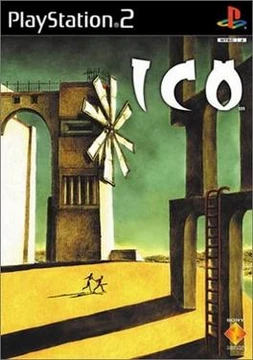
The Castle
A labyrinth of stone and water that devours the different and offers no mercy.

The Castle is the singular, all-encompassing setting of Ico (2001), the action-adventure game directed by Fumito Ueda and developed by Team Ico at Polyphony Digital. It is an ancient, decaying labyrinth of stone, water, and overgrown forest that serves simultaneously as the world, the maze, and the silent antagonist. Every corridor, flooded chamber, and crumbling tower belongs to this one structure, and the player never leaves it.
Within the game's sparse narrative, the Castle is a place to which those who are 'different' are taken and held. Yorda, a girl marked by horns and a spirit-nature, was carried here and imprisoned among the ruins. Ico enters the Castle to free her, and the structure itself becomes the obstacle: a shifting, waterlogged, moss-eaten labyrinth that tests the pair at every turn, culminating in the Colossus, its ancient guardian.
- Role
- Primary setting / labyrinth antagonist
- First appears
- Ico (2001, PlayStation 2)
- Developer
- Team Ico, Polyphony Digital
- Director
- Fumito Ueda
- Inhabitants
- Ico, Yorda, the Colossus
- Condition
- Ancient, decaying, overgrown with vegetation and water
- Scope
- Entire game takes place within the Castle
Lore & Background
The Castle predates any living memory in the game's world. Its walls are furred with moss, its floors slick with black water, and its upper reaches open onto grey skies through broken archways. Nature is slowly reclaiming the structure: roots split flagstones, trees push through collapsed ceilings, and thickets of pale grass fill what were once grand halls. There is no visible mechanism, no door that opens on a timer, no NPC to explain the layout. The Castle simply is, and it does not yield.
The game's minimal dialogue and environmental storytelling suggest the Castle is a place of exile or containment. Yorda was brought here because she was unlike the others, and the spirits of previous girls—faint, translucent figures seen drifting in certain chambers—imply she is not the first. The Castle does not guard a treasure; it guards a silence, a cycle of taking and holding. The Colossus, a towering armored figure that patrols the final stretch, is the last and most violent expression of that purpose.
Architecturally, the Castle is layered vertically and horizontally. The player moves through dense forested lower grounds, wades through flooded corridors where the water rises to the chest, climbs narrow staircases into wind-scoured upper towers, and descends again into darker, more confined passages. The layout is deliberately disorienting: paths loop, sightlines are broken by fog and falling leaves, and the only constant is the grey stone and the sound of dripping water.
In Their Own Story
The wind finds the gap in the eastern wall and pushes a single leaf across the flagstones. It rolls, catches on a root, and stops. In the flooded corridor below, the water laps at a stone bench where no one has sat in a hundred years. Somewhere above, in the upper gallery, a faint translucent figure drifts past a column and vanishes into the mist. The Castle breathes. It does not notice the two small figures—boy and girl, hands clasped—crossing the bridge in the forest. It has been waiting a long time. It will wait a little longer.
Reader's Guide
The Castle is not a character in the traditional sense; it is the world, the maze, and the silent adversary. Its narrative function is to isolate Ico and Yorda, to strip away any external help, and to force the bond between them to be the only tool that matters. Every room, every flooded passage, every crumbling bridge is a test of that bond.
Visually, the Castle is defined by a narrow palette: grey and ochre stone, deep green moss, black water, and pale overcast sky. Architecture is classical and grand but thoroughly decayed—broken columns, collapsed arches, shattered balustrades. Vegetation is aggressive: trees grow through floors, roots strangle walls, and thickets fill entire chambers. Lighting is diffuse and grey, with no strong directional sun, giving every space a muted, timeless quality.
Behaviorally, the Castle is a puzzle labyrinth. Water levels require the player to manage buoyancy and current. Narrow ledges demand precise platforming. Fog and limited sightlines create disorientation. There are no enemies in the early sections; the threat is the environment itself. The Colossus, appearing in the final stretch, is the Castle's only active guardian and the narrative climax: a towering, slow, armored figure that patrols a defined path, and which Ico must distract and eventually defeat to reach the exit.
For the player, the Castle functions as both challenge and atmosphere. It rewards patience, spatial memory, and the willingness to hold Yorda's hand through every uncertain step.
Did You Know?
- The entire game of Ico takes place within a single castle; the player never leaves its grounds from the opening forest to the final confrontation.
- The Castle's design philosophy, under Fumito Ueda, deliberately avoided visible UI elements, health bars, or maps, forcing the player to navigate purely through environmental cues and spatial memory.
- Faint, translucent figures of previous girls can be seen drifting in certain chambers of the Castle, implying Yorda is not the first to have been taken there.
- The Castle's water levels require the player to manage Yorda's buoyancy; if she sinks too low, the player must reach down and pull her up, reinforcing the hand-holding mechanic under pressure.
More in Characters
Elsewhere in the Ico universe
Spotted an error? Know more?
This is a living reference — every entry is fact-audited, and reader corrections feed straight into our audit queue. Suggest an edit · See this site's audit record