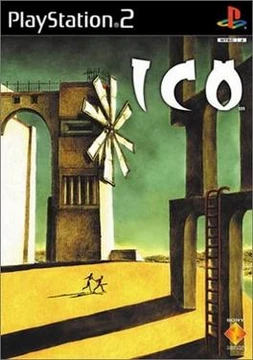
Ico and Yorda's bond
A hand held in the dark, across an entire castle, says everything words cannot.

Ico and Yorda's bond is the emotional and mechanical spine of the 2001 PlayStation 2 game *Ico*, developed by Team Ico and directed by Fumito Ueda. The entire narrative is carried not through exposition or cutscenes but through a single, persistent physical gesture: the player holds Yorda's hand with the right analog stick for the duration of the game. Their relationship—between a young boy and a girl who has been transformed into a shadow creature—unfolds in near-total silence across the corridors of a dark, decaying castle.
The bond functions simultaneously as story, gameplay, and theme. Yorda's vulnerability (she dissolves when exposed to light) and Ico's protectiveness (he must guide her away from illumination) create a loop of care and dependence that the player enacts with their own hands. By the time the two characters walk out of the castle together at the game's end, the player has spent hours performing an act of companionship that the game never once narrates in words.
- Ico
- Protagonist; young boy who enters the castle to rescue Yorda
- Yorda
- Companion; a girl transformed into a shadow creature who dissolves in light
- Core mechanic
- Hand-holding via the right analog stick; the player physically holds Yorda's hand throughout
- Setting
- A dark, multi-level gothic castle
- Dialogue
- Near-silent; Yorda speaks only a handful of words across the entire game
- Developer
- Team Ico (SCE Japan Studio)
- Director
- Fumito Ueda
- Platform
- PlayStation 2 (2001)
Lore & Background
Ico enters the castle under circumstances the game leaves largely unspoken. What is shown is a boy who, upon finding Yorda chained and half-dissolved in shadow, reaches for her. From that first grasp, the game's grammar changes: the right analog stick now controls a second body, and the player's attention splits between Ico's path and Yorda's fragility. Yorda is a shadow—she cannot exist in light. Every torch, every shaft of sun through a broken window, every lantern on a ledge is a threat to her. The player must constantly negotiate: turn Ico away, wait for the light to shift, carry her through darkness while the castle's architecture presses close.
The narrative is told through absence. There is no exposition, no voiced dialogue, no text. Yorda's entire spoken vocabulary across the game is a handful of syllables—her name for Ico, a single word of gratitude. Everything else is communicated through the architecture of the levels, the way Yorda hesitates at a ledge, the way Ico's animation shifts when he is alone versus when he holds her hand. The castle itself becomes a narrator: its corridors narrow, its floors drop, its shadows lengthen, and the two figures move through it as a single unit. The bond is not described; it is performed, frame by frame, by the player's own thumb on the stick.
The game's final act strips away the puzzles and the threats. Ico and Yorda walk, hand in hand, down a long corridor and out into open light. Yorda no longer dissolves. The shadow is gone. What remains is simply two figures walking together, the camera pulling back, the castle shrinking behind them. The bond that was a survival mechanic becomes, in those last moments, a quiet image of two people who have crossed a dark place and emerged on the other side still holding on.
In Their Own Story
The corridor is narrow and the stone is damp. Ico stops at the threshold where a single shaft of afternoon light cuts across the floor in a pale blade. Yorda does not stop. She steps forward, and where her shadow-foot meets the light, the edge of her form frays and thins, like ink dropped in water. Ico's hand tightens on hers. He pulls her back. They wait. The light shifts a few degrees as the sun creeps along the ceiling, and the blade of illumination slides past them, leaving only the cool grey of the corridor. Yorda's form solidifies again. She does not look at him. He does not look at her. They walk on, hand in hand, into the next dark room, and the sound of their footsteps on stone is the only language either of them speaks.
Reader's Guide
The hand-holding mechanic is the theme made physical. The moment Ico first grabs Yorda's hand in the chains, the right analog stick becomes a second body. From then on, you are not playing a character; you are holding one. The theme of mutual dependence is not told to you—it is enforced by your own thumb. Every corridor, every ledge, every puzzle requires you to think about two bodies moving as one, and the player's emotional state shifts from "I am solving a puzzle" to "I am keeping her safe."
Yorda's dissolution in light is the game's most visceral expression of vulnerability. Watch her edges soften and thin as she drifts toward a torch. There is no health bar, no warning icon. Just her form becoming translucent, then gone, and you must back Ico away from the light and wait for her to reconstitute. The theme here is fragility made mechanical: the player's hands literally pull her back from the edge of erasure.
The silence is the loudest design choice. Across the entire game, Yorda speaks perhaps three or four words. There is no voice acting, no exposition, no inner monologue. The player is left to fill the silence with their own emotional reading of the hand-holding. The theme of unspoken understanding is not a line of dialogue; it is the absence of one, sustained for hours, until the absence itself becomes the message.
The final walk out of the castle is the payoff. The puzzles stop. The threats stop. Ico and Yorda simply walk, hand in hand, down a long corridor and into open daylight. Yorda does not dissolve. The shadow is gone. The theme of the bond—carried entirely by the player's physical act of holding—resolves into a single, wordless image of two figures walking away from the dark. The game ends not with a victory fanfare but with the quiet sound of footsteps on a path, and the camera pulling slowly back.
Did You Know?
- The hand-holding mechanic is controlled entirely by the right analog stick; the player physically holds Yorda's hand for the duration of the game, and there is no option to release her.
- Yorda's entire spoken dialogue across the full game consists of only a handful of syllables—her name for Ico and a single word of gratitude. There is no other voiced dialogue.
- Team Ico, the development group behind the game, was a deliberately small team within SCE Japan Studio, and the game's minimal cast, single-location design, and near-total silence are direct consequences of that small sc
- Fumito Ueda, who directed Ico, went on to direct Shadow of the Colossus (2005), which shares Ico's hallmarks of minimal dialogue, a single companion, and a slow, contemplative pace.
More in Themes & Narrative
Elsewhere in the Ico universe
Spotted an error? Know more?
This is a living reference — every entry is fact-audited, and reader corrections feed straight into our audit queue. Suggest an edit · See this site's audit record