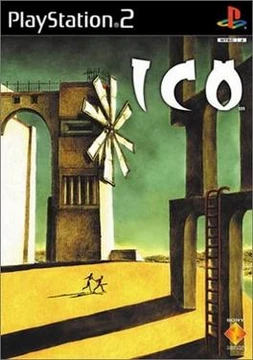
Ico
A boy, a girl made of shadow, and a castle that asks nothing of you but to keep walking.

Ico is a 2001 action-adventure video game developed by Team Ico, a small unit within Sony Computer Entertainment Japan Studio, and directed by Fumito Ueda. Released for the PlayStation 2, the game follows a silent boy named Ico as he traverses a vast, decaying castle to rescue a shadow-girl named Yorda, holding her hand throughout to anchor her to the physical world. Its near-total absence of dialogue, its handcrafted architecture, and its focus on a single emotional bond made it a landmark in Japanese game design.
In the broader landscape of video games, Ico occupies a singular position: a proof-of-concept that a game could be an experience of atmosphere, restraint, and tactile connection rather than spectacle or narrative density. It became the template for Ueda's subsequent works—Shadow of the Colossus and The Last Guardian—and is frequently cited in discussions of minimalism, player trust, and the expressive potential of empty space in interactive media.
- Developer
- Team Ico (SCE Japan Studio)
- Director
- Fumito Ueda
- Platform
- PlayStation 2
- Release year (Japan)
- 2001
- Genre
- Action-adventure
- Defining trait
- Near-zero dialogue; story told through environment and physical interaction
Lore & Background
The castle in Ico is not a dungeon in the conventional sense. It is a place of impossible geometry—corridors that open into vast courtyards, staircases that spiral into fog, rooms so large that the far wall is a suggestion rather than a boundary. There is no map, no objective marker, no enemy that speaks. The architecture itself is the puzzle, the antagonist, and the mood. Ico moves through it with a quiet desperation, and the player moves with him, guided only by the direction of wind and the pull of an unseen goal.
Yorda is a creature of shadow, bound to the castle by a curse whose terms are never stated. She flickers, vanishes into walls, and must be held by the hand to remain in the physical world. The act of holding her hand is the game's central verb: it is mechanical, emotional, and narrative simultaneously. There is no cutscene, no explanation, no reward screen. There is only the small, persistent contact between two figures in an empty space, and the slow dawning that the bond is the point.
The shadow creatures that populate the castle are not villains in any moral sense. They are obstacles, hazards, part of the environment's indifference. Ico does not defeat them in any lasting way; he evades, distracts, and moves on. The game's tension comes not from combat but from the fear of losing the hand, of the hand slipping, of the boy walking alone into a room that will not let him stay.
In Their Own Story
The hand slips. Just for a moment—fingers parting in the grey light of the upper corridor—and Yorda is gone, dissolved into the wall like smoke drawn through a keyhole. Ico presses his palm flat against the stone. The stone is cold. He walks to the next room. The next. He does not run. He does not call out. There is no voice to call with. He simply keeps walking, one hand trailing behind him, fingers open, waiting for the small weight to reappear in his grip. And it does. It always does. The hand closes around his, warm and faintly translucent, and they walk on together into the next empty hall, where the light is thinner and the silence is deeper and the castle, patient and vast, offers them nothing but the next stretch of floor and the next stretch of shadow.
Reader's Guide
Ico was built by a small team at SCE Japan Studio under Fumito Ueda, who wanted to prove that a game could carry emotional weight without a single line of spoken dialogue. The constraint was deliberate: no HUD, no inventory, no tutorial text. The player learns by falling, by being pulled back by a hand. The world received it as a quiet anomaly in the early 2000s, a game that trusted its audience.
Shadow of the Colossus carried the bond forward—Wander and Mono where Ico and Yorda had been—but broke the architecture. The enclosed castle opened into vast, empty plains. The single-antagonist structure (the castle itself as obstacle) became sixteen repeated encounters. Minimalism survived in the silence, in the lack of menus, in the way the world spoke through wind and stone rather than exposition.
The Last Guardian brought the companion back to the center. Trico is Yorda's heir: a creature you must hold, protect, and trust. Ueda's team was larger this time, the scope broader, but the core promise remained unchanged—a boy, a creature, and the slow, wordless act of learning to trust. The world, after years of delay, finally met the game on its own terms.
Did You Know?
- Ico was originally conceived as a multiplayer experience before being reworked into the single-player, companion-driven structure that shipped.
- The game contains no spoken dialogue whatsoever; all narrative is conveyed through environment, animation, and physical interaction.
- Fumito Ueda and Team Ico went on to direct Shadow of the Colossus (2005) and The Last Guardian (2016), both of which extend the companion-bond and minimal-dialogue philosophy established in Ico.
- The castle's design philosophy favored vast, open interior spaces over dense corridor-maze layouts, a deliberate break from the dungeon-crawler conventions common in early-2000s action-adventures.
More in Development & Legacy
Elsewhere in the Ico universe
Spotted an error? Know more?
This is a living reference — every entry is fact-audited, and reader corrections feed straight into our audit queue. Suggest an edit · See this site's audit record