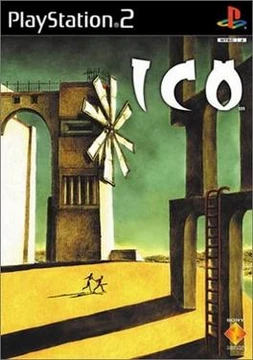
PlayStation 2
A boy, a girl made of shadow, and a castle that wants them both apart.

Ico is a 2001 action-adventure game for the PlayStation 2, developed by Team Ico within Sony Computer Entertainment Japan Studio and directed by Fumito Ueda. It follows a silent young boy who must traverse a ruined castle to rescue a girl named Yorda, a shadow-born creature who can pass through walls but is vulnerable to the castle's dark inhabitants. The game is defined by its near-total absence of HUD, text, or exposition; the player learns everything through spatial design, sound, and the physical act of holding Yorda's hand.
- Developer
- Team Ico (SCE Japan Studio)
- Director
- Fumito Ueda
- Platform
- PlayStation 2
- Release window
- 2001 (Japan / North America), 2002 (Europe)
- Genre
- Action-adventure
- Signature mechanic
- Hand-holding with Yorda; shadow-world traversal
- Legacy
- Direct design influence on Shadow of the Colossus (2005)
Lore & Background
The castle in Ico is less a location than a living antagonist. Its corridors shift, its staircases lead nowhere, and its shadow-creatures do not so much attack as *reclaim*—pulling Yorda back into the walls, the floors, the dark spaces between rooms. The architecture itself is the enemy: narrow gaps that force Ico to let go, chasms where Yorda's shadow form is the only way across, and locked gates that demand the boy solve a spatial puzzle while keeping his grip on a girl who might dissolve at any moment.
Yorda is never explained. She has no dialogue, no backstory delivered through cutscene. What the player understands is functional: she is light in a place of shadow, she can phase through solid matter, she is fragile, and she is the reason the castle's geometry keeps changing. The bond between Ico and Yorda is communicated entirely through the controller—through the resistance you feel when the camera swings, the way the hand-hold snaps if you move too fast, the quiet relief when a long stretch of corridor finally opens into a courtyard of pale, dusty light.
The game's ending reframes everything without a single line of exposition. The castle, the shadow, the rescue—each element recontextualizes the player's hours of careful, tender navigation. It is a story told in architecture and grip, and it left a permanent mark on how a single developer could use a console's raw power to create an experience that felt hand-built rather than produced.
In Their Own Story
The corridor is long and the light is the colour of old bone. Ico's bare feet slap stone. His right hand is full—Yorda's fingers, cool and faintly translucent, wrapped around his. Ahead, the wall breathes. A seam of darkness widens, and a shape peels itself from the plaster, limbs too long, face a suggestion. Ico does not run. He pulls Yorda closer, feels the shadow tug at her like a current under water, and steps sideways into the alcove where the torchlight still holds. The shape pauses. Studies them. Retreats into the wall with a sound like wet cloth tearing. Ico exhales. Yorda's grip tightens, just for a moment, and then they walk on, two small figures in a castle the size of a cathedral, holding on.
Reader's Guide
Team Ico was a small unit inside SCE Japan Studio, and the constraint was the point. Fumito Ueda and his team set out to prove that a PlayStation 2 title could be an experience of *restraint*—no HUD, no inventory, no quest log, no cutscene dialogue. The player should learn the world by touching it, by feeling the castle's geometry through the analog stick. The hand-hold mechanic was not a gimmick; it was the entire emotional grammar of the game. Every puzzle, every combat encounter, every corridor was designed around the question: *can you keep your grip?*
The world received Ico as a quiet miracle. Critics and players who had grown accustomed to sprawling, feature-dense action games found themselves holding a controller with one hand, the other resting on their knee, watching a boy and a shadow-girl cross a courtyard in silence. It sold modestly by blockbuster standards, but its influence was out of proportion to its numbers.
When Shadow of the Colossus arrived in 2005, the through-line was clear and deliberate. The bond carried over—not as a literal companion, but as the emotional engine: a fragile, wordless connection that gives the player's actions weight. The minimalism carried over: no HUD, no map, no dialogue boxes. The single-antagonist structure carried over: one castle, one set of colossi, a focused narrative arc rather than a branching quest tree. What broke away was the puzzle-box architecture. SotC opened the space into vast, wind-scoured plains and replaced precise corridor navigation with large-scale, rhythmic combat. The hand-hold became the sword-grip; the shadow became the wind. The tenderness remained, but the scale had changed, and the castle had become a world.
Did You Know?
- Ico contains no on-screen text, no HUD elements, and no voiced dialogue; the player learns every rule of the game purely through spatial design and physical interaction.
- The hand-hold mechanic with Yorda introduces a deliberate physical constraint: moving too quickly or swinging the camera too sharply can cause the grip to break, pulling Yorda toward the shadow world.
- Ico's development at SCE Japan Studio directly led to the formation of the team and design philosophy behind Shadow of the Colossus (2005), both directed by Fumito Ueda.
- The game's castle is designed so that Yorda's ability to pass through walls is not a power-up but a vulnerability—she is constantly at risk of being drawn back into the architecture by the castle's shadow-creatures.
More in Development & Legacy
Elsewhere in the Ico universe
Spotted an error? Know more?
This is a living reference — every entry is fact-audited, and reader corrections feed straight into our audit queue. Suggest an edit · See this site's audit record