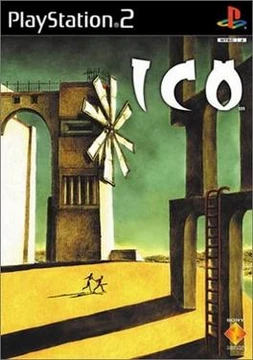
The Gate
One door, one girl, one boy holding her hand in the dark.

In Ico, the Gate is the narrative and mechanical terminus of the entire journey: a massive stone-and-wood threshold deep within the castle that Yorda must pass through to be freed from her curse. It is not merely a level exit but the story's destination, the reason Ico carries a torch, crosses rope-spanned chasms, and wields a sword in the final stretch. Every item and mechanic in the game exists to shepherd the two characters toward that single doorway.
The supporting equipment—the torch, the rope, the brief sword sequence, and the key that unseals the gate—functions less as a traditional inventory and more as a sequence of narrative beats. Each one is a small test of the bond between Ico and Yorda before the quiet, wordless act of stepping through the Gate together.
- Game
- Ico
- Developer
- Team Ico (Sony Computer Entertainment)
- Director
- Fumito Ueda
- Platform
- PlayStation 2
- Release year
- 2001
- Genre
- Action-adventure
Lore & Background
The castle in Ico is a place of silence and shadow, its corridors lit only by the torch Ico carries. Yorda, a girl marked by a curse that slowly turns her into a creature of the dark, can only remain in the physical world while that light is near her. The Gate at the castle's heart is the sole means of breaking that curse, a threshold beyond which she will be whole again. The architecture between the starting courtyard and that final doorway is the entire world the player inhabits: crumbling stone, overgrown gardens, and the ever-present threat of the shadow creatures that dwell in unlit spaces.
The relationship between the two characters is told without a single word of dialogue. Ico leads; Yorda follows. The torch in his hand is both a practical light source and a symbol of that responsibility. When the torch is set down, Yorda flickers and dims, a constant visual reminder that his presence is the only thing keeping her tethered to the world. The Gate, therefore, is not just an objective—it is a promise made to her by the act of guiding her there.
The shadow creatures that guard the final approach are the castle's immune system, rejecting the two intruders. The sword Ico briefly wields is the one ugly, violent note in an otherwise gentle game, and its brevity is deliberate: the story is about carrying someone through the dark, not about killing what lives in it.
In Their Own Story
The torch guttered in the draft that poured through the broken archway. Ico set it on the stone ledge and watched Yorda's outline soften at the edges, her fingers becoming translucent against the grey afternoon. She did not look at him. She never did. She was already half-there, half-there, the way a word on the tip of the tongue is almost spoken.
He picked the torch back up. The light steadied. Her hand, small and cool, found his again.
They walked. The rope stretched taut over the chasm, and he crossed first, then reached back. The shadow things hissed from the walls, and the sword sang once, twice, a clumsy and ugly sound that did not belong in this quiet place. Then it was over, and the silence returned, thicker than before.
The Gate stood open at the end of the hall, its great wooden doors parted just enough for one person to slip through. Yorda stopped. She turned. For the first and only time, she looked at him.
Then she walked through, and the light behind her went out.
Reader's Guide
The torch is Ico's primary tool and Yorda's lifeline. Mechanically it provides light in dark corridors and keeps Yorda's form stable—without it she fades into shadow and the player loses the ability to guide her. It is found at the game's start and carried throughout. Narratively it represents Ico's protective role: he is the light that holds her to the physical world.
The sword appears only in the final stretch of the castle, used to fend off the shadow creatures that swarm in the last area. Mechanically it is a simple melee weapon; narratively it is almost an afterthought, a brief violent interlude before the quiet of the gate. Its presence underscores that Ico's journey is not a combat game.
The rope is encountered in mid-game sections where gaps in the castle must be crossed. It functions as a traversal tool, anchoring Ico and Yorda to ledges. As a narrative beat it reinforces the theme of connection and deliberate, careful movement.
The key, used to unseal the final gate, is the last mechanical gate before the ending. It transforms the gate from a static backdrop into an active threshold that must be deliberately opened, mirroring Yorda's own choice to step through.
The Gate itself is the destination: a large stone-and-wood doorway at the castle's heart. Reaching it is the entire purpose of the game; passing through it is Yorda's release.
Did You Know?
- Ico was developed by a very small team within Sony Computer Entertainment's Japan Studio, led by Fumito Ueda, who later directed Shadow of the Colossus.
- The game contains no spoken dialogue and no on-screen text; the entire story is conveyed through environmental design, character animation, and sound.
- Ico originated as a technology demonstration for the PlayStation 2's graphics capabilities before being expanded into a full narrative experience.
- The shadow creatures that guard the final area are the only enemies the player must actively fight; every other threat in the castle is navigational or environmental.
Elsewhere in the Ico universe
Spotted an error? Know more?
This is a living reference — every entry is fact-audited, and reader corrections feed straight into our audit queue. Suggest an edit · See this site's audit record