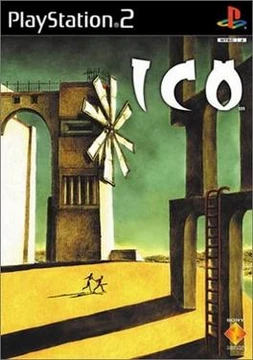
Deliberate absence of HUD/health bars
No numbers, no maps, no text — just a boy, a shadow girl, and a castle that wants to swallow you both.

Ico (2001, PlayStation 2) is a single-player action-adventure developed by Team Ico at SCE Japan Studio under director Fumito Ueda. The game's most defining design choice is its complete refusal of a heads-up display: there is no health bar, no minimap, no inventory screen, no on-screen text of any kind, and no objective markers. The player navigates a vast, decaying castle entirely through spatial reading, sound, and the physical relationship between the boy Ico and the shadow-girl Yorda.
This absence is not a technical limitation but a deliberate aesthetic and emotional statement. By removing every numerical abstraction between the player and the world, the game forces you to feel danger through the body of Ico—his stumbling, his being seized by shadow creatures, his small hand gripping Yorda's—rather than watching a bar drain. The result is a tension that is spatial, temporal, and deeply personal, and it has made Ico a touchstone for interface design in games that follow.
- Game
- Ico
- Platform
- PlayStation 2
- Developer
- Team Ico (SCE Japan Studio)
- Director
- Fumito Ueda
- HUD elements present
- None — no health bar, no minimap, no text, no inventory, no objective markers
- Player characters
- Ico (boy) and Yorda (shadow girl)
- Setting
- A single crumbling castle on a coastal cliff
Lore & Background
In the world of Ico, the castle is not merely a setting but an antagonist. Its corridors shift, its floors give way, and the shadow creatures that patrol its halls are not enemies in the conventional sense; they are the castle's immune system, hunting the two intruders who have broken its seal. There is no lore screen, no codex, no NPC who explains the backstory. The player learns the world the way a child would: by touching, by falling, by watching what happens when the lights go out and the shadows lengthen.
The absence of a HUD is thematically inseparable from Yorda's nature. She is made of shadow, the same substance that constitutes the game's threats. There is no UI element to tell you "Yorda is safe" or "Yorda is in danger." You know only by looking at her, by the way she trembles, by the way the shadow men's fingers close around her form. The game asks you to develop a parental, protective intuition that no health bar could simulate. You are not managing a resource. You are holding a hand.
Fumito Ueda has spoken in interviews about wanting the player to feel the weight of the world physically rather than numerically. The camera, the pacing, the silence between footsteps—all of it is calibrated so that the player's body, not a menu, becomes the interface. When Ico is grabbed and dragged, you feel it in the controller's haptic pulse and the sudden lurch of the camera. There is no red flash, no "YOU DIED" card. There is only the dark, and then the light again, and the hand you must reach for.
In Their Own Story
The corridor smells of wet stone and old iron. Ico's bare feet slap the flagstones in a rhythm he doesn't choose. Ahead, Yorda stands at the edge of a chasm, her shadow-form flickering where the torchlight can't quite reach. She does not turn. She does not speak. She simply waits, the way a held breath waits to break.
Behind them, the sound of dragging. Not footsteps—dragging. The shadow men move like that, low and wet, their fingers trailing across the floor. Ico's hand is already outstretched. He does not think. He grabs. Her fingers close around his, cold and faintly wrong, and the camera dips to show the two of them small against the vast dark throat of the castle.
He pulls. She follows. The rope bridge sways. Below, the sea is black and indifferent. There is no bar to tell him how much rope is left. There is only the creak, the creak, the creak, and the hand he will not let go of.
Reader's Guide
The hand-holding mechanic is rendered with extraordinary physicality. A single button press grips Yorda's hand, and the camera shifts to frame both figures together. You see Ico's small hand wrapped around hers, her shadow-fingers interlacing with his flesh. There is no companion-AI indicator, no distance meter, no "Yorda is following" prompt. You simply hold her hand, and she walks. Let go, and she stops. Walk too far, and she lags, her form flickering with a physical reluctance. This creates a vulnerability no health bar could convey: you are not protecting a number. You are protecting a person made of the same darkness that threatens you. The "co-op" here is not split-screen. It is one player performing the emotional labor of two. You must look back. You must wait. You must choose, in real time, whether to solve a puzzle alone or bring her along and risk the shadow men seizing her.
The puzzles are architectural. The castle is a vertical labyrinth of crumbling stone, rope bridges, and shadow-infested halls. There are no objective markers, no glowing waypoints. You read the environment: a swaying rope suggests a crossing. A door too high suggests you must raise Yorda. A creature patrolling a corridor suggests another path. The tension is spatial and temporal, not numerical. You feel the clock in your shoulders, not in a timer.
When danger comes, there is no warning icon. There is only the sound, the shadow, and the hand you reach for.
Did You Know?
- Ico contains no on-screen text whatsoever—no dialogue boxes, no item names, no menu labels. Every interaction is communicated through iconography, sound, and animation.
- The game was developed by a very small team within SCE Japan Studio, which allowed the director to treat interface design as a narrative choice rather than a technical default.
- Fumito Ueda, Ico's director, went on to direct Shadow of the Colossus and The Last Guardian, both of which carry forward the philosophy of minimal, diegetic interfaces.
- When Ico is seized by a shadow creature, there is no traditional 'game over' screen. The player simply respawns at the last safe point, with no penalty counter, no score, no statistics.
More in Gameplay & Mechanics
Elsewhere in the Ico universe
Spotted an error? Know more?
This is a living reference — every entry is fact-audited, and reader corrections feed straight into our audit queue. Suggest an edit · See this site's audit record